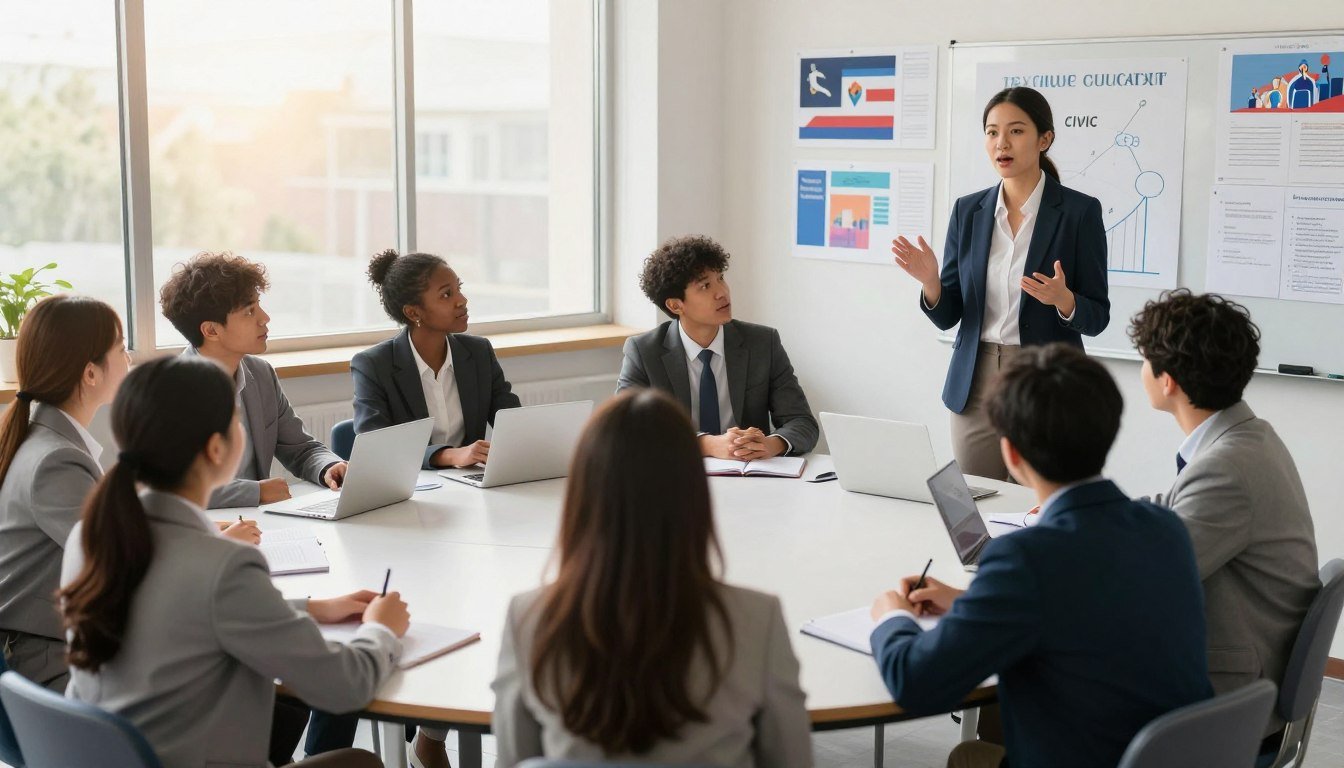
What if the real test of a democracy isn’t on Election Day, but in how well we prepare our youth for it?
This question strikes at the heart of a national concern. A 2010 report showed only 24 percent of 4th, 8th, and 12th graders were proficient in civics. Knowledge levels have stalled for years.
Schools hold a powerful key. They shape the moral and social development of young people. Engaging students in community life early is a strong predictor of their future participation.
Programs like We the People, born from the 2001 No Child Left Behind Act, aimed to build this competence. They sought to foster a sense of duty and understanding.
The task now is urgent. We must prioritize developing informed citizens. These individuals grasp the complex balance between personal rights and collective responsibilities.
Key Takeaways
- Early involvement in civics strongly predicts future community engagement.
- Learning institutions are critical for shaping responsible, community-minded individuals.
- National assessment data reveals stagnant proficiency levels in civics knowledge.
- Creating informed citizens who understand both rights and duties is essential for democracy.
- Historical initiatives, like We the People, provide a foundation for civic learning.
- A focus on practical, engaging instruction is key to reversing current trends.
Understanding the Impact of Civic Education
From Aristotle to modern surveys, the connection between civic understanding and democratic health remains clear. The ancient philosopher believed a strong state needed virtuous, active people. Today, data shows we are making progress but still have work to do.
The 2021 Annenberg Civics Knowledge Survey found 56% of Americans can name all three branches of government. This is a big jump from 26% in 2016. Yet, a large portion still struggles with these basics.
Role in Building Informed Citizens
Good programs do more than teach facts. They empower young people to connect their personal views with how government works. This process turns abstract ideas into practical knowledge.
Students learn how collective decisions are made. They see where their opinions fit into the larger system. This builds a sense of personal duty and capability.
Impact on Community Engagement
This learning naturally leads to local action. Initiatives like New Hampshire Listens show the power of community dialogue. When people understand the system, they are more likely to get involved.
Local involvement is essential for a healthy nation. It sustains the connections between neighbors and their leaders. Schools that foster this understanding help bridge a critical gap.
They link individual concerns with the functioning of government. This creates a pipeline of informed, engaged citizens ready to participate.
The Historical Evolution of Civic Education
Long before modern democracies, societies recognized the need to cultivate individuals who could contribute to the common good. This foundational idea has shaped centuries of thought on how people learn their role in public life.
From Ancient Greece to Modern Democratic Ideals
The ancient Greeks had a term for this process: paideia. It was the formative journey that developed a person’s abilities for the benefit of both family and the city-state, or polis. Personal virtue was seen as the only way to ensure excellence for the entire community.
This classical ideal emphasized that strong societies depend on strong individuals. The goal was to make every person an asset to the public sphere.
Key Milestones in American Civic Instruction
Later thinkers built upon these ideas. John Locke argued that a gentleman’s true calling was to serve his country through moral and political knowledge. Yet, he also warned that such education must balance with protecting personal freedom.
This tension defines much of American history. The evolution of civics learning here reflects a constant push-and-pull between state requirements and the desire for individual liberty. Philosophers like Rousseau also shaped this dialogue, suggesting that true learning helps one function in society while keeping natural freedom.
Civic Education in the United States
A student’s understanding of government often depends more on their zip code than on a unified national curriculum.
This variation stems from differing state-level policies. While all 50 states have social studies standards, only 39 mandate a specific government course for high school graduation.
State Standards and Curricular Requirements
A 2012 CIRCLE report highlights this patchwork. The lack of a uniform national test is another gap. Only eight states require students to pass a state-mandated civics exam to graduate.
Contemporary Challenges and Initiatives
The 2001 No Child Left Behind Act shifted focus to reading and math. This reduced classroom time for social studies in many districts.
Teachers now face a dual challenge. They must meet state standards while also creating meaningful, participatory experiences.
Some policymakers suggest using the U.S. citizenship test as a graduation requirement. This idea remains controversial among administrators.
Without strong accountability, the priority given to this subject has declined in many schools.
Foundations of Democratic Participation
In Federalist 51, James Madison laid out a vision where the people’s vigilance, not just governmental structure, secures liberty. He argued the primary control on government is its dependence on citizens through elections. This means true democratic participation requires specific skills.
People must be able to evaluate policy and hold leaders accountable. A healthy society relies on individuals balancing private interests with public needs.
Real involvement goes beyond casting a ballot. It demands an active commitment to understanding the procedures that shape our lives. This is the way to build a resilient republic.
By fostering these abilities, schools prepare citizens to navigate a modern democracy. Strong civic education builds the confidence and moral responsibility needed for full participation.
Integrating Civic Education with Public Policy
The most effective civic learning occurs when theoretical knowledge intersects with tangible policy applications. This approach shows students the direct impact of government decisions on their local communities.
Abstract concepts become real when linked to neighborhood issues. People see how rules and regulations shape their daily lives.
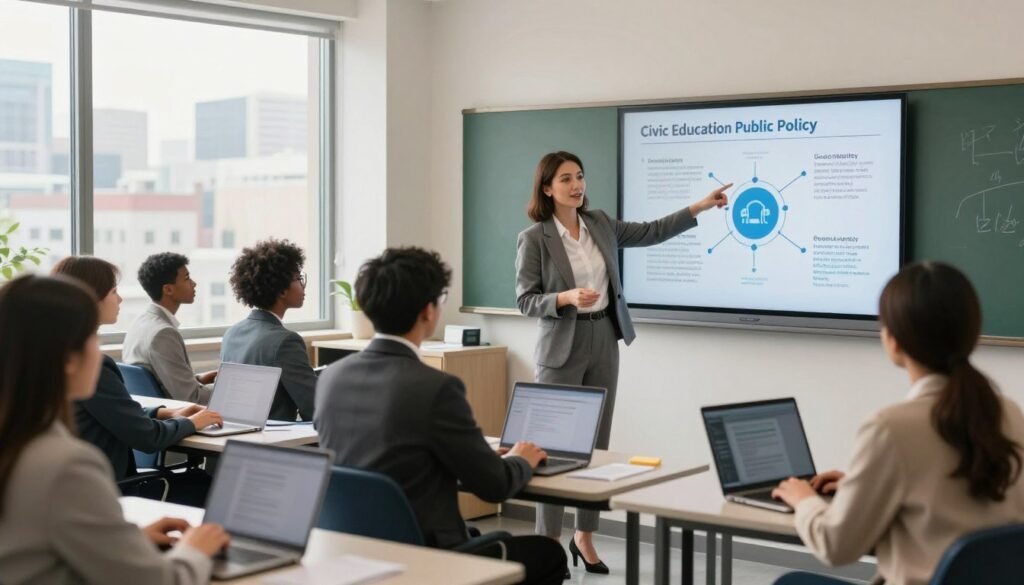
Institutions like the Carsey School of Public Policy train future leaders to bridge communities and government. Their graduate programs in Community Development prepare individuals for this essential work.
Programs such as the Washington, DC Colloquium connect classroom theory with real-world practice. This focus demonstrates that government structures exist to facilitate collective decision-making for everyone’s benefit.
The Role of Digital Media in Civic Engagement
The 21st century has fundamentally reshaped how young people connect with the world around them. Digital platforms are now primary spaces for community involvement and political discussion.
Social Media’s Influence on Youth Participation
Access is nearly universal. A 2007 Pew Research Center study found 95% of teens had internet access. Eighty percent used social networking sites.
These tools allow youth to construct their political identities. They share opinions on social topics with peers across the globe.
Digital networks also enable coordinated action. Young people organize local volunteerism and activism for causes like human rights.
Educators now use Media Literacy Frameworks. This instruction teaches respectful and productive interaction in online communities.
The shift is significant. For many students, civic engagement has moved from a dutiful obligation to a form of personally expressive politics.
Teaching Democratic Values in Schools
Schools become laboratories for democracy when students are given a real voice in their own environment. Philosopher John Dewey championed this view. He saw the school as a mini-community where young people learn through active participation and deliberation.
Effective instruction must move beyond memorizing government facts. The goal is to foster a deep understanding of the values that sustain the system. This means creating daily opportunities for students to practice these principles.
Genuine participation is key. When schools let students help shape rules or discuss school issues, they feel respected. This respect builds a sense of personal empowerment about their role in society.
This approach breaks the cycle of disengagement. It turns abstract civics lessons into lived experience. By building a culture of mutual respect, we prepare informed citizens who are ready to engage.
Innovative Civic Education Practices
Modern classrooms are transforming into dynamic workshops where young people don’t just learn about democracy—they practice it. This shift moves instruction beyond memorization. The goal is to build real-world understanding through direct participation.
Frameworks like the C3 from the National Council for the Social Studies guide this change. They emphasize deliberating public issues and connecting learning to community service. Role-playing and simulations let students experience how government works firsthand.
Service-learning provides a hands-on experience. It links classroom studies to local needs. Analyzing current events helps students grasp the complexities of modern political life.
Digital tools create an engaging environment that mirrors their world. These methods empower young people to identify problems. They learn to participate in building collective solutions for their own communities.
Strategies for Implementing civic education in Schools
Project Citizen, an initiative by the Center for Civic Education, exemplifies how to foster responsibility in the classroom. This program provides essential resources to help build civic competence.
A comprehensive approach is needed. It must blend direct instruction with active participation in the school system. This integration turns abstract lessons into practical understanding.
Successful methods create a learning environment where young people feel valued. They become empowered to contribute to their community. This sense of ownership is crucial for lasting engagement.
Educators should adopt pedagogical approaches that encourage critical analysis. Collaborative problem-solving within the classroom prepares students for complex discussions. These skills are vital for informed participation.
Aligning lessons with real-world applications ensures that learning remains relevant. It connects classroom knowledge to local and national issues. This strategy keeps students engaged and informed throughout their academic journey.
Bridging the Gap Between Public Policy and Civic Engagement
Lucy Heisey’s work with NH Listens shows how grassroots dialogue can make policy feel personal and accessible. As an MPP student and fellow, she operates outside formal government structures. This approach helps people directly connect their opinions to public policy.
Many feel lawmaking is distant and complex. This perception leads to a decline in public trust. It also erodes general knowledge of how the system functions.
Initiatives like NH Listens tackle this by relating policy concerns to local government. They create spaces where people feel heard and valued by the institutions that serve them. This process is vital for restoring confidence.
A deep understanding of the legislative process empowers individuals. They learn to elevate their own voices while respecting others. This fosters genuine civic engagement and strengthens community bonds.
Community-Based Approaches to Civic Education
Real understanding of our shared responsibilities grows from conversations held close to home, where people tackle local problems together. Programs like New Hampshire Listens show how this works. They engage diverse communities in direct dialogue about the issues that matter most to them.
These initiatives create a respectful space for everyone’s voice. The goal is collaborative work toward common solutions. This process helps neighborhoods address complex challenges from the ground up.
For educators and researchers, this approach is vital. It grounds their study in the real-life experiences of the people they aim to serve. Theory connects directly with on-the-ground reality.
This form of learning is not confined to a classroom. It is a lifelong process that happens within families, faith groups, and local organizations. Engaging individuals in their own neighborhoods builds a powerful sense of ownership. People feel responsible for the well-being of their local area.
Student Empowerment through Civic Instruction
Media literacy has become a fundamental skill, as vital as reading or writing, for navigating modern society. The Commission on Youth Voting and Civic Knowledge calls it a core competency. This skill allows each student to analyze information and participate effectively.
True empowerment begins when young people have a voice in the structures that shape their lives. When a student feels genuine respect in class, that sense of capability follows them into adulthood. Educators create these opportunities through collaborative learning.
This approach ensures every young person feels valued. The goal is to build the practical skills needed to understand and influence the political world. Effective education prepares students not just with knowledge, but with confidence.
Challenges and Opportunities in Civic Education
A startling knowledge gap persists, as many Americans cannot identify their own state representatives. A 2018 Johns Hopkins survey found that 80% could not name their state legislator. This highlights a major hurdle for democratic participation.
One great challenge is the lack of consensus on how to best prepare people. Without clear agreement, programs vary widely in quality and focus. This inconsistency affects outcomes nationwide.
Despite these issues, many opportunities exist to improve public knowledge. Digital tools and community-based initiatives offer new pathways. They can make complex structures of government relevant to daily life.
When individuals struggle to name their representatives, their ability to influence government weakens. Educators must find ways to connect lessons to local concerns. By addressing these challenges, schools can create meaningful engagement.
Creative approaches can turn obstacles into openings. Interactive platforms and local projects help bridge the gap. They provide hands-on experience with how the system works.
This effort builds a foundation for lasting involvement. It empowers people to participate fully in their communities.
Comparing Traditional and Modern Approaches
Two distinct eras in teaching democratic participation reveal a shift in both method and mindset.
The 20th-century model in many schools stressed dutiful citizenship through rote learning. Students memorized facts about government structures. The goal was knowledge transmission.
Today’s approach is different. Modern education emphasizes the experience of active participation. Young people engage with current political issues through projects and digital collaboration.
Differences in Instructional Methods
Traditional instruction often involved passive listening and textbook study. Contemporary methods prioritize hands-on work.
Students might simulate legislative debates or analyze real-world case studies. Digital tools are now central.
They allow learners to discuss controversial issues in safe, moderated spaces. This peer-to-peer interaction builds critical thinking skills.
Lessons from History and Current Trends
History shows that this type of learning is a developmental process. Each generation requires tailored approaches.
The move from dutiful to expressive politics reflects broader social changes. This educational work connects classroom lessons to community experience.
Educators can refine their work by blending historical wisdom with modern tools. This prepares students for the complexities of the 21st century.
Future Trends and Policy Implications
Arthur Lupia’s research into political knowledge gaps provides a crucial roadmap for the next era of civic instruction. His book “Uninformed” asks why people know so little about politics. The answers point directly to future needs for our society.
A major trend will focus on how schools prepare individuals. The goal is to navigate the complex, information-rich environment of the 21st century. This work moves beyond simple facts.

Strong policy support from government is vital. It ensures the long-term health and stability of our communities. Investment in engagement programs is a necessary foundation.
As we advance in this century, the work of educators is clear. They must ensure all people have access to high-quality learning. Future research should explore how schools foster skills for holding government accountable.
The ultimate aim is to build a society where informed citizens are actively involved. They will shape their collective future through sustained participation and understanding.
Conclusion
Ultimately, the strength of our nation rests on the foundation of knowledgeable and engaged individuals. This learning provides essential skills for active participation in our communities. It remains a vital part of a healthy society.
Schools play a crucial role. They must offer instruction that builds respect for others and a deep understanding of democratic life. This work prepares citizens to lead in the 21st century.
Our approach must blend traditional values with innovative methods. By learning from the past, we can seize new opportunities for engagement across all states.
Looking ahead, we must prioritize this need to sustain our democratic system. The ongoing way of engaging people ensures a resilient future for everyone.
FAQ
Why is learning about government and participation so important for young people?
This type of learning helps young people understand how their community and nation work. It builds the knowledge and skills needed to participate effectively. Informed individuals are better equipped to contribute to society and address public issues.
How has teaching about democracy changed over the years in America?
Instruction has evolved significantly. Early efforts focused on basic civics and patriotism. Over time, it expanded to include critical thinking about complex issues, the analysis of primary sources, and hands-on projects that connect classroom lessons to real-world action.
What are some common hurdles schools face with this part of the curriculum today?
Many schools struggle with limited time and resources, often prioritizing tested subjects like reading and math. There can be a lack of consistent state standards and trained instructors. Additionally, engaging a diverse student body in meaningful discussion about current events presents an ongoing challenge.
Can digital tools and social media play a positive role in youth engagement?
A>Yes, when used thoughtfully. Platforms like Instagram and TikTok allow young individuals to access information, organize around causes, and express their views. The key is teaching media literacy—how to find reliable sources, think critically about online content, and engage in respectful dialogue.
What does an innovative classroom practice look like for this subject?
Innovative practices move beyond textbooks. They include project-based learning, like students identifying a local issue and proposing a solution to the city council. Simulations of democratic processes, such as mock trials or legislative debates, also provide powerful, experiential learning.
How can community organizations support this kind of learning?
Local groups, non-profits, and government offices offer vital partnerships. They can provide guest speakers, serve as sites for internships or service-learning projects, and supply real-world contexts for student work. This bridges the gap between theoretical knowledge and practical application.
What is the main goal for students who receive strong instruction in this area?
The ultimate goal is empowerment. It aims to equip every young person with the confidence and capability to be an active, informed member of their community. This means they can vote thoughtfully, serve on local boards, advocate for change, and collaborate with others to solve problems.