

What if the most powerful force shaping your daily life isn’t the law itself, but how it’s carried out? This unseen engine drives our communities, turning political ideas into the services we rely on.
This vital work is the implementation of public policies designed to solve pressing social and economic issues. It’s the backbone of a functioning society.
The field is both an academic study and a hands-on professional practice. It focuses on the efficient management of affairs within the public sector.
Understanding these essentials reveals how our civic operations function to serve the broader world. Professionals in this sector ensure resources meet the population’s needs.
Key Takeaways
- It acts as the crucial link between political decisions and the real-world experiences of citizens.
- This work involves managing complex government programs that address national issues.
- It is defined as both a scholarly discipline and a practical career path.
- Grasping its core requires insight into how governmental bodies deliver services.
- Dedicated experts work to align the management of communal resources with public demand.
- The primary goal is the effective execution of policy for societal benefit.
- It represents a dynamic and essential component of a modern nation’s structure.
Introduction to Public Administration
Imagine a framework where every law and policy is given life through organized action and management. This systematic process is essential for a functioning society. It turns political decisions into tangible services.
According to the North American Industry Classification System (NAICS 91), this sector includes establishments engaged in governmental activities. Public policy provides the blueprint for these actions. It sets proposed steps to solve community problems.
What is Public Administration?
It is often described as the translation of political intent into the reality citizens experience. This work involves implementing programs that address social and economic needs. Effective execution requires understanding how policies are made and evaluated.
An Overview of the Field
The field is both an academic discipline and a professional practice. It focuses on the efficient management of affairs within the governmental sphere. Students gain knowledge to navigate complex operations and service delivery. The primary goal is achieving desired societal outcomes through structured governance. Understanding this framework is key for anyone interested in how government works.
History and Evolution of Public Administration
Long before modern departments and agencies, ancient empires developed sophisticated systems to govern their people. This journey from early rule to contemporary practice shows a constant drive for better organization.
From Ancient Roots to Modern Reforms
Early systems, like those in ancient China, valued merit over birthright. For centuries, however, jobs were often given as political favors.
Major reforms later shifted the focus. The new goal was professional expertise and a merit-based civil service. This was a fundamental change in how administration worked.
Key Milestones and Influential Theorists
German sociologist Max Weber revolutionized the study of organizations in the 1900s. His theory of bureaucracy described a structured, rule-based system.
Another key moment was the 1968 Minnowbrook Conference. Led by scholar Dwight Waldo, it sparked the “New Public Administration” movement. This event pushed the field toward greater social equity.
Modern practice builds upon this deep historical knowledge. The evolution of public administration provides crucial lessons for our complex world today.
Core Principles and Fundamentals
How does a complex policy become a reliable service in your community? The answer is found in core management fundamentals.
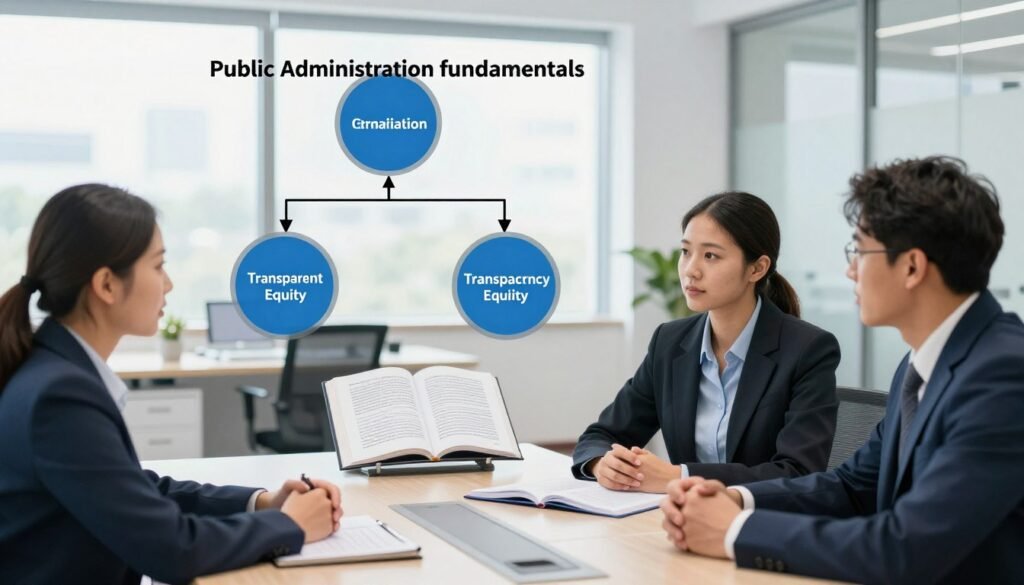
Bureaucracy, Management, and Policy Execution
A key framework is Luther Gulick’s POSDCORB acronym. It outlines essential managerial duties: planning, organizing, staffing, directing, coordinating, reporting, and budgeting.
This systematic approach is vital for executing policy. It ensures governmental programs run smoothly and deliver consistent results.
Bureaucracy provides the necessary structure. It manages resources and implements legislative mandates at every level.
Mastering these fundamentals leads to high standards. Every community service benefits from clear accountability and transparency.
Intergovernmental Relationships in the Public Sector
Think of the U.S. government not as a single machine, but as a network of interconnected gears. Federal, state, and local entities must work in sync for policies to function smoothly. This complex web defines modern governance.
Dynamics Between Federal, State, and Local Agencies
Professionals in this field navigate a landscape of shared power. They ensure cooperative working relationships prevent one agency’s actions from harming another’s goals. This coordination is vital for serving diverse community needs.
Financial decisions have wide-reaching effects. Overspending by one entity can create serious funding issues for others relying on the same budget pool. A deficit at the state level often forces tough choices locally.
Cultivating reliable partnerships across all levels is essential. A balanced and effective public sector depends on this constant collaboration. Understanding these dynamics is key for anyone managing civic resources.
Organizational Theory in Public Administration
Organizational theory provides the blueprint for how groups of people coordinate efforts to achieve common goals. These frameworks are essential for structuring any large-scale operation.
They offer leaders a roadmap for designing effective systems and motivating their workforce. This is especially critical within the complex public sector.
Classical vs. Neo-Classical Models
Classical organizational theory implements a rigid, scientific approach to management. It was widely adopted during the Industrial Revolution to boost factory efficiency.
This model views an organization as a machine. It prioritizes strict hierarchies and standardized procedures above all else.
The Neo-Classical model, or Human Relations Theory, shifts the focus. It emphasizes the human element and interpersonal interaction within teams.
This theory recognizes the unique traits and creative potential of individual employees. Morale and social dynamics are seen as key drivers of productivity.
Modern Systems and Contingency Approaches
Contingency theory emerged as a flexible response to a volatile environment. It argues there is no single best way to structure all organizations.
The optimal design depends on specific external factors and internal needs. This allows for greater adaptability in a fast-changing world.
Modern Systems Theory encourages entities to capitalize on data collection. Leaders monitor how different divisions impact the whole entity’s performance.
By applying these evolving theories, leaders in public administration can better manage their organizations. The goal is to maximize efficiency and successfully adapt to new circumstances.
Public Administration in the United States
Two key moments in American history fundamentally shaped how the nation’s executive branch operates today. These events established core principles for managing federal operations.
Woodrow Wilson’s Legacy and Reforms
Woodrow Wilson published “The Study of Administration” in 1887. This seminal essay argued for a clear division between politics and the daily work of government.
His ideas promoted efficiency and professional management. Wilson is widely recognized as a founding figure in the field for this reason.
The Reorganization Act of 1939 created the Executive Office of the President. Championed by Franklin D. Roosevelt, this law reshaped the executive branch’s structure.
It centralized advisory and management functions. This reform remains a cornerstone of how the United States coordinates its federal activities.
Wilson’s legacy and the 1939 Act continue to influence the execution of public policy. Scholars analyze them to understand modern program delivery and national governance.
Exploring Careers and Educational Pathways in Public Administration
With millions employed in government roles across the nation, the demand for skilled professionals in this field remains strong. The Brookings Institution estimates that about 15% of United States employees hold positions within the public sector.
Career Opportunities and Roles
This sector offers a wide array of positions dedicated to public service. One key role is the city manager, who earns a median salary of $159,600 for overseeing complex municipal operations.
Other vital positions include policy analysts, budget directors, and non-profit leaders. These professionals work at federal, state, and local levels to deliver essential community services.
Educational Degrees, Certifications, and Training
Aspiring public administrators often start with an undergraduate degree in a related field. Many then pursue a Master of Public Administration (MPA) to gain advanced leadership skills.
Established institutions like Norwich University, founded in 1819, offer online MPA programs for working professionals. These programs emphasize strategic planning, fiscal management, and improving service delivery.
This training prepares students for successful careers as effective administrators. The goal is to equip them to manage programs that directly benefit their communities.
Public administration: Challenges and Innovations
In an era of rapid change, those who manage civic operations must innovate to stay effective. This field faces constant tests, from shifting policy landscapes to evolving public expectations.
Adapting to Policy Shifts and Technological Change
Historical events, like the 1974 Watergate scandal, eroded citizen confidence in government. Rebuilding this trust remains a core challenge.
Today’s leaders must also navigate fast technological change. They leverage data-driven governance to adapt and solve complex problems. This approach improves service delivery and operational efficiency.
Leveraging Data and Collaborative Governance
Collaborative governance brings diverse groups together. It finds new answers to persistent policy issues affecting community public affairs.
Administrators need agility to meet new demands while keeping processes honest. Embracing innovation helps the sector overcome systemic hurdles. This allows it to better serve the population’s evolving needs.
Meeting Public Needs and Driving Social Change
Access to education, safe shelter, and reliable utilities forms the bedrock of community well-being. Driving positive social change depends on how effectively these fundamental needs are met. This is the ultimate goal of responsive civic leadership.

Responsive Governance and Community Engagement
Responsive governance requires officials to listen directly to the people. They must understand local concerns to formulate effective solutions. This ongoing dialogue is vital for addressing complex public affairs.
Leaders utilize their professional skills to implement policies that tackle tough issues. These include matters of law, public safety, and human rights. Their work ensures communities receive essential services from their governmental organizations.
Effective stewardship of shared resources keeps entities accountable at all levels. Building trust through transparent communication is the best way to manage expectations. This approach is crucial during periods of transition or policy change.
Conclusion
The true measure of a society’s structure lies in how well it serves its citizens every day. This discipline remains critical for the effective management of complex programs and the faithful execution of policy.
Professionals in this field use advanced degree training to navigate the public sector. They drive meaningful change where it matters most.
A successful career here demands a deep commitment to service and constant skill development. As the field evolves, innovative strategies will be essential to meet the needs of the state.
Ultimately, studying public administration empowers individuals to make a lasting impact. It prepares dedicated leaders to guide our communities with ethics and vision.
FAQ
What exactly does this field of study cover?
This field focuses on the implementation of government policy and the management of public programs. It involves organizing people and resources to deliver essential services to communities. Professionals in this area work on everything from urban planning and budgeting to environmental protection and social welfare.
How has the practice of managing government changed over time?
Its evolution spans from ancient bureaucratic systems to modern reforms. Key milestones include the progressive era and the rise of new public management. Thinkers like Max Weber and Woodrow Wilson shaped its core theories on organization and the separation of politics from day-to-day operations.
What are the foundational ideas behind running public sector organizations?
Core fundamentals include structured bureaucracy, efficient management, and effective policy execution. These principles ensure that laws passed by legislatures are translated into tangible services and that public resources are used responsibly and accountably.
Why is the U.S. context significant in this discipline?
The United States has been a major influence, particularly through Woodrow Wilson’s essay calling for a professional, non-political civil service. This legacy paved the way for modern reforms that emphasize efficiency, ethics, and a focus on serving the public good at all levels of government.
What kind of career paths are available with a degree in this area?
Graduates pursue diverse roles as city managers, policy analysts, budget directors, and non-profit leaders. Educational pathways include a Master of Public Affairs (MPA) degree, certifications in specialized areas like project management, and ongoing training in leadership and data analysis.
What are the biggest challenges facing the public sector today?
Current challenges include adapting to rapid policy shifts, integrating new technology, and managing complex intergovernmental dynamics. Innovations like data-driven decision-making and collaborative governance models are key to addressing these issues and meeting community needs effectively.