
What if your capital could unlock more than just financial returns—it could open doors to living and working in America?
The United States offers specialized pathways for international entrepreneurs who want to establish or support American enterprises. These programs serve a dual purpose: they fuel economic growth while providing qualified individuals with legal status to reside and operate businesses in the country.
Navigating this landscape requires understanding the different categories available. The two primary options—the EB-5 Immigrant Investor program and the E-2 Treaty Investor pathway—differ significantly in requirements and outcomes.
Each option has distinct investment amounts, job creation mandates, and immigration benefits. Making the right choice depends on your financial capacity, business objectives, and long-term goals.
This comprehensive guide examines the requirements, application processes, and strategic considerations for successfully obtaining these opportunities. Foreign entrepreneurs must navigate complex regulations while addressing business, tax, and legal factors to maximize their success.
Key Takeaways
- Specialized pathways exist for international entrepreneurs seeking to invest in American businesses
- These programs benefit both the U.S. economy and qualified individuals
- Different categories have varying investment requirements and immigration outcomes
- The EB-5 and E-2 are the two main options with distinct characteristics
- Success requires understanding complex regulations and strategic planning
- Business, tax, and legal considerations are crucial for maximizing outcomes
- Choosing the right pathway depends on individual financial capacity and goals
Overview of U.S. Investor Visas
Foreign nationals looking to establish operations in the United States can leverage specialized immigration pathways tied to economic contributions. These programs connect capital deployment with legal residency opportunities.
Understanding the U.S. Business Environment
The American market offers unparalleled access to consumer spending and advanced infrastructure. Diverse industries from technology to manufacturing present numerous opportunities.
Legal protections for company owners create a stable foundation for enterprise growth. This environment supports both established corporations and new ventures.
Long-Term Benefits of Investing in the U.S.
Strategic capital placement can lead to permanent residency and eventual citizenship. Family members gain access to American education systems and healthcare.
Business growth potential combines with participation in a robust economic system. The right investment type aligns with both commercial and personal objectives.
Key Investor Visa Options: EB-5 and E-2
When capital deployment aligns with immigration goals, the EB-5 and E-2 categories offer contrasting approaches. These programs serve different objectives with distinct requirements and outcomes.
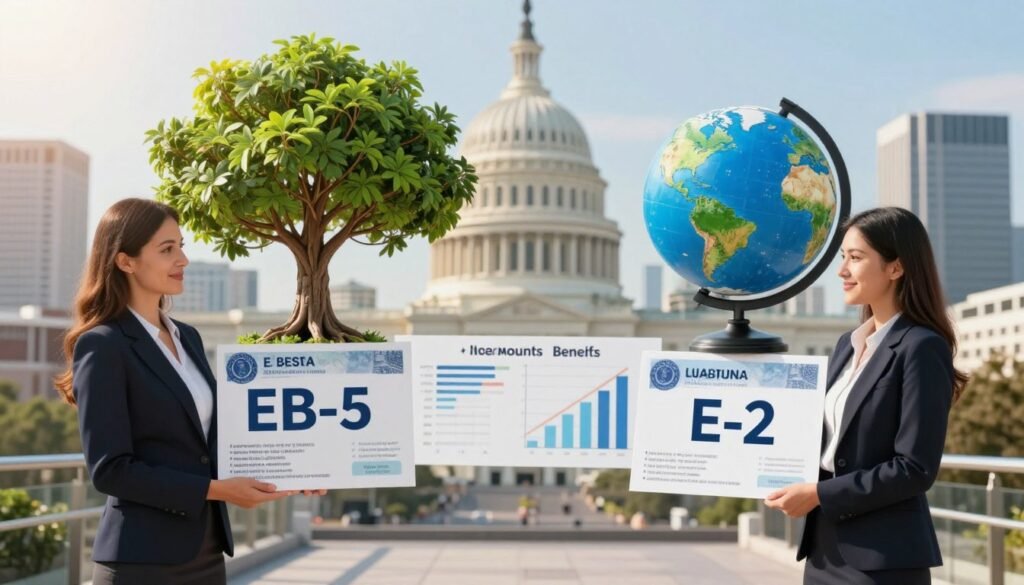
EB-5 Immigrant Investor Visa Fundamentals
The EB-5 visa provides a direct route to permanent residency. This immigrant investor program requires substantial capital commitment.
Minimum investment amounts start at $1.05 million or $800,000 in targeted employment areas. The program mandates creating ten full-time jobs for American workers.
Successful applicants receive green cards for themselves and immediate family members. Annual limits exist with special allocations for rural and high-unemployment areas.
E-2 Treaty Investor Visa Essentials
The E-2 treaty investor category offers a non-immigrant alternative. This option requires smaller capital amounts and focuses on active business management.
Investment levels typically range from $100,000 to $200,000 depending on the enterprise. Applicants must maintain at least 50% ownership and direct involvement.
This visa can be renewed indefinitely while the business remains operational. It does not lead directly to permanent residency like the EB-5 program.
Essential Requirements for Visas for Investors
Successful navigation of American investment programs depends on understanding specific financial and operational mandates. These requirements form the foundation for qualification and approval.
Both capital deployment and employment generation standards must be met precisely. The criteria vary significantly between different program categories.
Capital Investment and Funding Sources
The financial commitment represents a critical component of any application. EB-5 programs require substantial investment amounts starting at $1.05 million.
Targeted employment areas may qualify for reduced $800,000 thresholds. Acceptable capital includes cash, business assets, and secured loans.
Documentation must prove legal acquisition of all funds. Tax returns and business records provide essential evidence.
Job Creation and Business Operation Criteria
Employment generation stands as another fundamental requirement. EB-5 mandates creating ten full-time positions for qualified U.S. workers.
These positions must be established within two years of approval. The new commercial enterprise must engage in lawful, profit-seeking activities.
Business structures can include corporations, partnerships, or limited liability companies. Each model must demonstrate legitimate commercial operations.
Navigating the Investor Visa Application Process
The journey from investment to legal residency requires careful navigation of specific administrative procedures. This pathway involves submitting detailed evidence and following strict timelines.

The application process begins with thorough document preparation. Applicants must gather proof of investment sources and business plans.
Submitting Your Petition and Required Documentation
EB-5 candidates file Form I-526 with U.S. Citizenship and Immigration Services. This immigrant petition requires comprehensive supporting evidence.
Current processing times average approximately 48.5 months. Timelines vary based on application volume and complexity.
Adjustment of Status vs. Consular Processing
After petition approval, applicants choose between two pathways. Adjustment of status allows changing immigration status within the United States.
Consular processing requires attending an interview at a U.S. embassy abroad. Successful applicants receive an immigrant visa stamp for entry.
EB-5 recipients initially get conditional green cards valid for two years. Removing conditions requires submitting Form I-829 with additional evidence.
Strategic Considerations for U.S. Business and Investment
Beyond financial requirements, thoughtful risk assessment determines long-term success in U.S. investment pathways. Each option presents unique challenges that require careful evaluation before committing capital.
Evaluating the Risks and Rewards of Each Visa Option
The EB-5 program carries significant regulatory uncertainty. Congress must periodically renew this initiative, creating potential application gaps.
Early submission provides protection against program changes. Those with pending petitions maintain eligibility during legislative interruptions.
Capital must be genuinely at risk in commercial ventures. There is no guarantee of return, and complete financial loss remains possible.
Regional Center investments involve additional considerations. Investors surrender operational control and depend on project management integrity.
Legal and Tax Implications in U.S. Investments
American corporate law varies significantly by state. Choosing the right jurisdiction affects regulatory requirements and legal protections.
Tax obligations require coordination between U.S. and home country systems. Double taxation treaties may provide relief for international entrepreneurs.
Professional guidance from experienced attorneys is essential. They help navigate complex regulations while minimizing exposure.
Comprehensive planning addresses corporate structure, employment law, and intellectual property protection. These factors collectively influence enterprise sustainability.
Conclusion
Making the final decision between American investment pathways requires weighing immediate goals against long-term vision. Both the EB-5 and E-2 options offer distinct advantages for foreign nationals seeking to combine capital deployment with residency objectives.
The EB-5 immigrant investor program provides a direct route to permanent status through substantial capital commitment and job creation. This pathway leads to a green card for the applicant and their family after a multi-year process.
Alternatively, the E-2 treaty option offers more flexibility with lower investment amounts. While it doesn’t directly lead to permanent residency, it allows for renewable stays while actively managing a U.S. enterprise.
Successful navigation demands professional guidance to address complex legal, tax, and business considerations. The right choice ultimately depends on individual circumstances, risk tolerance, and long-term objectives in the United States.
FAQ
What is the main difference between an EB-5 and an E-2 visa?
The EB-5 visa is an immigrant program leading to a green card. It requires a larger capital investment and focuses on job creation for U.S. workers. The E-2 is a non-immigrant treaty investor visa. It needs a smaller investment but does not provide a direct path to permanent residency.
How much money do I need to invest for an EB-5 visa?
The standard EB-5 investment amount is
FAQ
What is the main difference between an EB-5 and an E-2 visa?
The EB-5 visa is an immigrant program leading to a green card. It requires a larger capital investment and focuses on job creation for U.S. workers. The E-2 is a non-immigrant treaty investor visa. It needs a smaller investment but does not provide a direct path to permanent residency.
How much money do I need to invest for an EB-5 visa?
The standard EB-5 investment amount is $1,050,000. If you invest in a targeted employment area (TEA), the required capital is $800,000. These funds must be at risk to benefit the U.S. economy.
Can my family come with me on an investor visa?
A> Yes. For both the EB-5 and E-2 categories, your spouse and unmarried children under 21 can obtain derivative status. This allows them to live, and in most cases, work or study in the United States.
What are the job creation requirements for the EB-5 program?
You must create or preserve at least 10 full-time jobs for qualified U.S. workers within two years of the investor’s admission. This is a key requirement to maintain your conditional permanent resident status.
How long does the application process typically take?
Processing times vary. E-2 treaty investor visa processing can be faster, often taking several months. The EB-5 immigrant investor process is more complex and can take several years from application to receiving a green card.
What is a Regional Center, and how does it relate to the EB-5 visa?
A Regional Center is a USCIS-approved entity that manages EB-5 capital into a specific geographic area. Investing through a Regional Center can offer more flexibility in meeting the job creation criteria for your application.
,050,000. If you invest in a targeted employment area (TEA), the required capital is 0,000. These funds must be at risk to benefit the U.S. economy.
Can my family come with me on an investor visa?
A> Yes. For both the EB-5 and E-2 categories, your spouse and unmarried children under 21 can obtain derivative status. This allows them to live, and in most cases, work or study in the United States.
What are the job creation requirements for the EB-5 program?
You must create or preserve at least 10 full-time jobs for qualified U.S. workers within two years of the investor’s admission. This is a key requirement to maintain your conditional permanent resident status.
How long does the application process typically take?
Processing times vary. E-2 treaty investor visa processing can be faster, often taking several months. The EB-5 immigrant investor process is more complex and can take several years from application to receiving a green card.
What is a Regional Center, and how does it relate to the EB-5 visa?
A Regional Center is a USCIS-approved entity that manages EB-5 capital into a specific geographic area. Investing through a Regional Center can offer more flexibility in meeting the job creation criteria for your application.